




After over two centuries of exploration and development, magnesium materials and their alloys have found significant application value in industries such as 3C, automotive, and medical. This guide covers the history of magnesium materials, common magnesium alloy grades and their properties, magnesium alloy production processes, applications, advantages, and future trends.
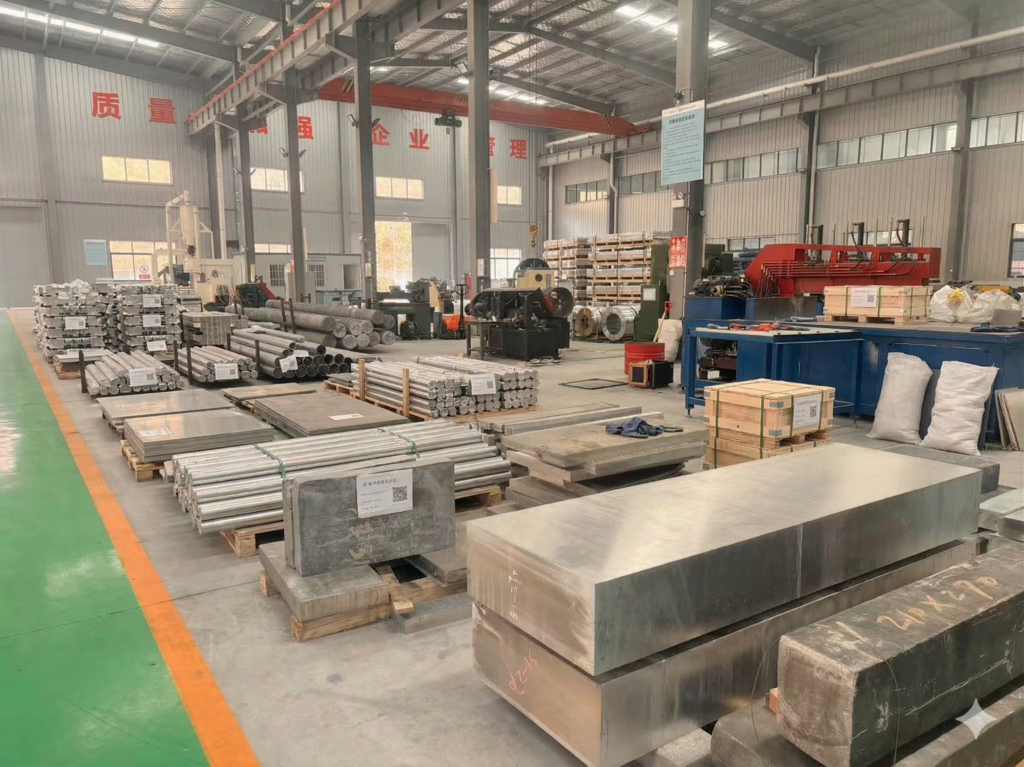
What Is Magnesium Material?
In the periodic table of chemical elements, magnesium (Mg) ranks 12th and belongs to the Group IIA alkaline earth metals. It is named after the ancient Greek city of Magnesia. Magnesium has a relative atomic mass of 24.305 and its element symbol is Mg. Pure magnesium has a density of 1.738 g/cm³ and is classified as a non-ferrous light metal. The density of different alloys varies depending on their chemical composition. Magnesium exhibits a silvery-white metallic luster but readily oxidizes and tarnishes in air. Magnesium resources are abundant, with its content in the Earth’s crust reaching up to 2.7%, and the magnesium content in the ocean can be as high as 70%. China is a major country in terms of magnesium resources, with the main production areas concentrated in the provinces of Shanxi, Ningxia, and Shaanxi.
History Of Magnesium Material?
The discovery of magnesium can be traced back to the 17th century. In 1618, an English farmer named Henry Wicker noticed that the water in his well had a bitter taste, and his cows refused to drink it. However, he observed that the water had a healing effect on sores, and it became known as Epsom salts, later identified as magnesium sulfate.
In 1755, Scottish chemist Joseph Black, in his paper describing the difference between calcium carbonate and magnesium carbonate (magnesia alba), identified it as a new element.
Humphry Davy, a British chemist, is widely credited as the first to discover magnesium in 1808. He isolated an impure form of magnesium by electrolyzing a mixture of magnesium oxide and mercuric oxide. Due to the presence of mercury, the resulting magnesium was impure. Davy named it ‘magnesium’. To date, the discovery of magnesium is 217 years old. Notably, in 1828, French chemist Antoine Bussy produced a purer form of magnesium by reducing magnesium chloride with potassium. The magnesium industry experienced rapid development starting in the 19th century, and during World War II, global magnesium production reached 32,000 tons per year. With current technological advancements, the extraction of magnesium has become much simpler, and its applications in industry are increasingly concrete.
How is Magnesium Produced?
There are two main methods for magnesium production:
1.Molten Salt Electrolysis: In the 1970s, electrolysis of brine was the primary method for obtaining magnesium. The magnesium chloride in the brine is dehydrated in an HCl gas atmosphere.
2.Thermal Reduction Method: Due to increased demand for magnesium, electrolysis could no longer meet the supply. In 1913, the vacuum thermal reduction method of magnesium chloride began. In 1949, France initiated a semi-continuous silicon thermal reduction process for magnesium production. This method has become the mainstream magnesium production method in today’s magnesium industry
Classification of magnesium alloys
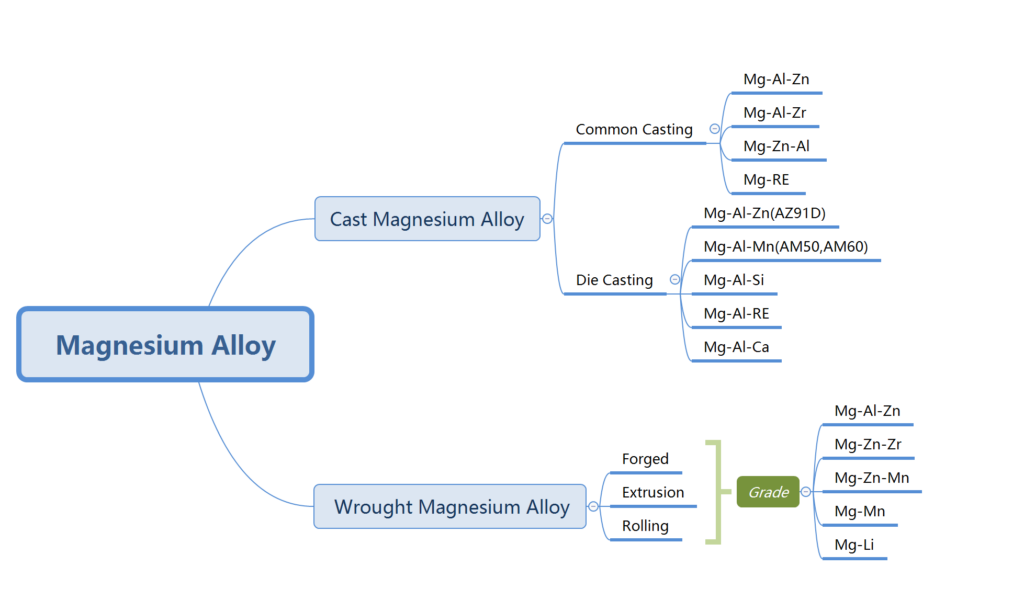
Due to its lower performance, industrially pure magnesium is rarely used in industrial applications. Consequently, the majority of magnesium is utilized in the production of magnesium alloys and magnesium-aluminum alloys. There are various methods for classifying magnesium alloys; the following shows a classification based on processing technology
Common Grade of Magnesium Alloy
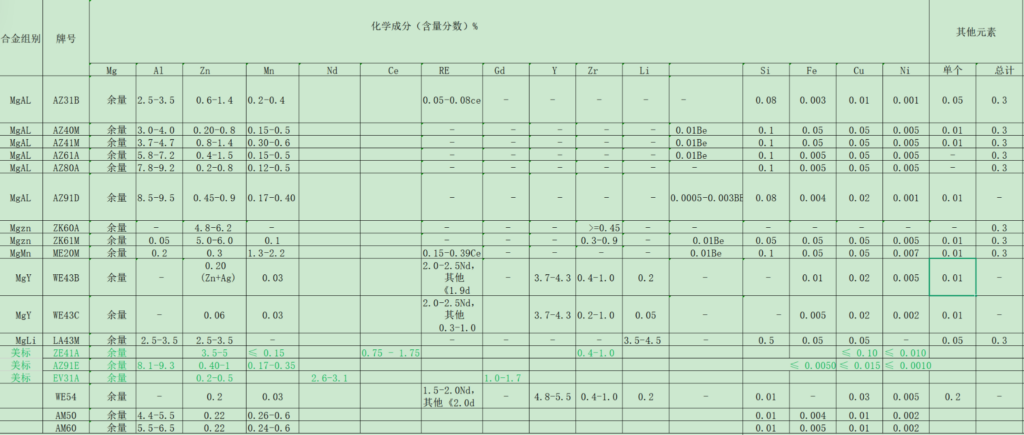
Internationally, the ASTM (American Society for Testing and Materials) designation system for magnesium alloys is commonly used to represent magnesium alloy grades. This system consists of letters, numbers, and letters. The initial letters represent the main alloying elements, and the numbers indicate the approximate content of the primary alloying components. The final letter signifies different developmental stages of the alloy. For example, AZ31B is a magnesium alloy containing approximately 3% aluminum and 1% zinc, and it is the second registered alloy with this standard composition
Different Grade of Magnesium alloy Property
Different magnesium alloy grades exhibit variations in their chemical compositions, mechanical properties, and physical properties. Below is a table of chemical compositions for common grades for your reference
Magnesium alloy Corrosion Resistance
Magnesium has a standard electrode potential of -2.37V, making it a highly electronegative metal with inherently poor corrosion resistance. The presence of elements like iron and copper in magnesium alloys also significantly impacts their corrosion resistance. To enhance the corrosion resistance of magnesium alloys, surface treatments such as anodizing, micro-arc oxidation, electroplating, and spraying can be applied
5 Types Process Of Magnesium Alloy
- Casting
Cast magnesium alloys represent the oldest processing technique, with die casting accounting for 90% of all casting processes. Currently, it is commonly used in the production of automotive parts, car frames, and car wheels. Due to the rapid development of various industries, semi-solid forming, rapid solidification, and spray deposition casting methods are also now employed
- Forged
Forging is a process where a forging hammer or press applies pressure to a magnesium alloy billet through a hammerhead or die, causing it to plastically deform. Currently, magnesium alloy forging includes two main processing methods: open-die forging and closed-die forging
- Extrusion
Extrusion is a processing method where a billet is loaded into an extrusion cylinder, and pressure is applied through an extrusion ram, forcing it to flow through a die orifice and undergo plastic deformation. This processing technique is primarily used for magnesium products such as magnesium alloy bars, tubes, profiles, and wires. Solid magnesium alloy profiles and bars can be produced using direct extrusion, while hollow magnesium alloy profiles and tubes can utilize indirect extrusion.
- Rolled
Rolling is a plastic deformation process where a billet, placed between rotating rolls, undergoes a reduction in its cross-sectional area and a change in shape due to the pressure applied by the rolls. Generally, the rolling process can be divided into cold rolling, warm rolling, and hot rolling. Cold-rolled magnesium alloy products are mainly thin sheets and ultra-thin sheets. Hot rolling is primarily used for the production of thick and extra-thick magnesium alloy plates
- Welding
Magnesium alloys exhibit good welding performance, with the primary welding methods currently employed being argon arc welding (GTAW), gas welding, and resistance welding. Argon arc welding is predominantly used for magnesium alloys, offering a high weld strength coefficient and minimal welding deformation. Magnesium alloy welding wires of the same material can be used as filler metal. Currently, argon arc welding is used to repair castings, with vibration platforms being a major application both domestically and internationally
Application of Magnesium alloy
Due to its properties such as light weight, shock resistance, antimagnetism, and environmental friendliness, magnesium alloys have a wide range of current applications. Scenarios that might be suitable for you include
1.Electronics (3C Industry): Modern technological advancements are driving electronic devices to be lighter and thinner, while also demanding high density, high strength, strong electromagnetic shielding capabilities, and ease of processing and forming. Consequently, magnesium alloys have become an ideal material for manufacturing electronic device housings, such as the outer casings of mobile phones, laptops, and cameras.
2.Transportation Industry: The current energy crisis and environmental concerns have made energy conservation and emission reduction in automobiles and motorcycles critical issues. This has led to a more extensive application of magnesium alloys in automotive lightweighting. Currently, magnesium alloy die-castings are used in automotive transmission housings, clutch housings, seat frames, wheel hubs, door frames, and roof racks.
3.Aerospace: Due to the extreme conditions in aerospace, the material performance requirements for magnesium alloys are high. The main grades currently used in aerospace include ZK60A, AZ91, ZE41, and WE43.
4、Mechanical Industry: In the textile industry, magnesium alloys are mainly used for needle bars and yarn separators.
5、Printing: Magnesium alloy engraving plates and etching plates, due to their smooth surface, fine detail reproduction, and ease of processing, have become essential for high-quality hot stamping.
6.Other Industries: In pyrotechnics and lighting, magnesium powder is highly flammable, making pure magnesium rods and fire starters used in the outdoor industry common magnesium products. Magnesium powder is also widely used in various fireworks, flares, and illuminating bombs.
Benefits of Using Magnesium Alloy
Due to its inherent characteristics, magnesium alloys offer significant advantages:
1.Lightweighting: With a density of 1.738 g/cm³, magnesium is currently the lightest structural metal in the world. It is 36% lighter than aluminum alloys and 73% lighter than zinc alloys. This property enables the reduction of energy consumption and pollutant emissions in transportation vehicles such as automobiles and motorcycles, making it an excellent material for lightweighting in aerospace and transportation.
2.Excellent Machinability: Magnesium alloys are easy to cut and process due to their strong stability, resulting in better machining accuracy. Currently, we can achieve tolerances within 0.05mm.
3.Good Vibration Damping Performance: Magnesium alloys possess high vibration damping capacity. Consequently, they are frequently used in applications requiring shock absorption and noise reduction, such as in automobiles and vibration testing equipment.
4.Excellent Weldability: The excellent welding performance of magnesium alloys facilitates the direct joining of components made from the same material.
5.Recyclable: Magnesium is a green metal, non-toxic to the environment, and 100% recyclable, resulting in a minimal environmental impact.”
Magnesium Alloy Challenges & Limitations
Despite its numerous advantages, magnesium alloys also have certain drawbacks and limitations
1.Magnesium alloys are highly susceptible to oxidation and combustion. Therefore, smelting requires the use of specialized flux coverage, and fire prevention measures must be taken during processing.
2.Magnesium alloys exhibit poor resistance to saltwater corrosion, necessitating anti-corrosion treatments
3.The material properties of magnesium alloys are generally not as high as those of aluminum. High-performance magnesium alloy materials can often be very expensive
Magnesium Alloy Future Trends
With the advancement of technology, various industries are increasingly pursuing lightweighting, thinness, and environmental friendliness, particularly the automotive, electronics, and aerospace sectors. Consequently, the demand for magnesium in 2026 is expected to continue its growth.
The main differences between magnesium alloys and titanium alloys are: 1. Weight—magnesium alloys weigh only 40% as much; 2. Mechanical properties—the mechanical properties of magnesium alloys are far inferior to those of titanium alloys; 3. Machinability—magnesium alloys are very easy to machine due to their low hardness, whereas titanium alloys are very difficult to machine and therefore more expensive due to their high hardness.