




- 1. What an Electronic Enclosure Must Do
- 2. Magnesium Compared With Common Housing Plastics
- 3. Thinner Walls Can Reduce Product Weight
- 4. Better Heat Management Than Plastic
- 5. Built-In EMI Shielding
- 6. Dimensional Stability and Product Durability
- 7. Manufacturing and Cost Considerations
- 8. Recycling and Environmental Value
- 9. Is AZ91D Right for Every Electronic Housing?
- 10. What Buyers Should Provide Before Requesting a Quote
- 11. Frequently Asked Questions
- 11.1. Is magnesium lighter than plastic?
- 11.2. Does a magnesium housing help cool electronics?
- 11.3. Can magnesium replace EMI coatings on plastic?
- 11.4. Is AZ91D suitable for high-temperature electronics?
- 11.5. Which electronic products can use magnesium housings?
- 12. Final Takeaway
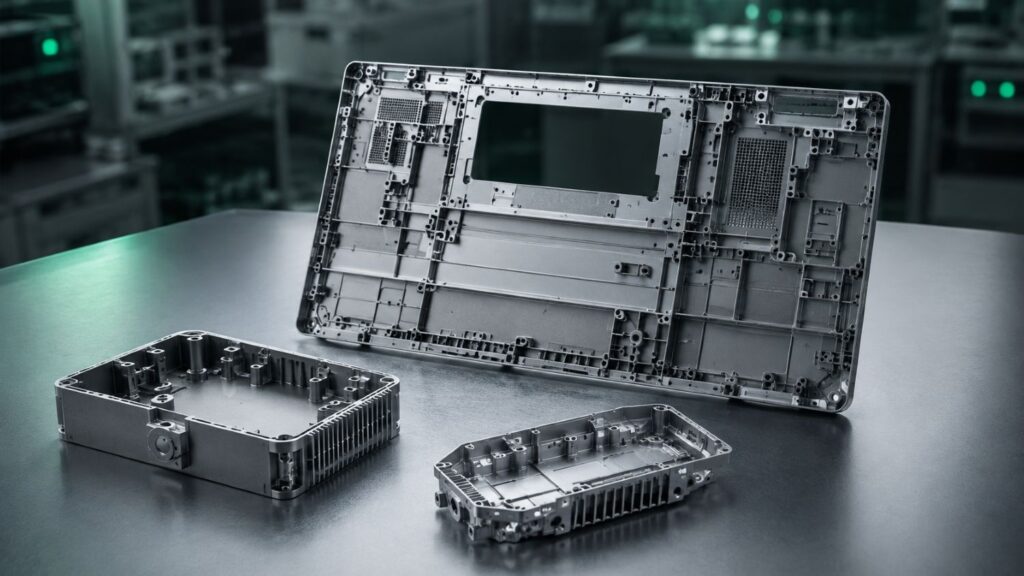
Modern electronics need more than a good-looking outer shell. The enclosure has to be light, thin, strong, accurate, and durable. It may also need to move heat away from internal parts and block electromagnetic interference.
That is a difficult combination for one material.
Engineering plastics are easy to mold, but thin plastic walls can lose stiffness quickly. Aluminum is strong, but it may add more weight than the design allows. Magnesium fills the gap with low density, high specific stiffness, useful heat transfer, and built-in EMI shielding.
For buyers evaluating magnesium alloy electronic enclosures, the real question is not whether magnesium is light. It is whether the material can improve the complete product while keeping manufacturing practical.
What an Electronic Enclosure Must Do
Portable electronics place several demands on the housing at the same time.
The enclosure should:
- Keep the product light and compact
- Resist impact, vibration, and everyday handling
- Hold tight dimensions around internal parts
- Move heat away from sensitive components
- Reduce electromagnetic interference
- Accept a durable, attractive surface finish
- Support efficient machining and high-volume forming
- Remain recyclable at the end of the product’s life
Different products weigh these needs differently. A notebook housing may focus on stiffness, heat, and dimensional stability. A phone or communication device may place more value on weight and EMI shielding. A projector or heat sink needs better thermal performance.
Magnesium Compared With Common Housing Plastics
The source material compares AZ91D magnesium with several engineering plastics used for electronic housings.
| Material | Density (g/cm³) | Elastic modulus (GPa) | Tensile strength (MPa) |
|---|---|---|---|
| ABS | 1.23 | 2.25 | 55 |
| PC/ABS | 1.25 | 2.53 | 60 |
| PC/ABS with 20% glass fiber | 1.35 | 5.80 | 100 |
| PC with 10% glass fiber | 1.25 | 6.67 | 105 |
| AZ91D magnesium alloy | 1.80 | 45 | 233 |
Magnesium is denser than plastic, but the finished enclosure can still be lighter because the walls can be thinner and much stiffer.
This is the number that matters to a product designer: finished part weight, not raw material density by itself.
Thinner Walls Can Reduce Product Weight
The source gives a direct housing comparison. A typical personal-computer plastic shell used a 2.2 mm wall. Replacing it with a 0.82 mm magnesium alloy wall reduced weight by 46% and increased tensile strength by about 1.4 times.
Early production programs also demonstrated 1.0 mm notebook housings and semi-solid molded magnesium shells with wall thicknesses around 0.6 to 0.7 mm.
These are historical examples, but the design lesson is still useful. Magnesium can reduce enclosure thickness without giving up the rigidity needed to protect internal components.
For the customer, that can mean a smaller product, less weight to carry, and a housing that feels more solid in the hand.
Better Heat Management Than Plastic
Electronic components generate heat, and that heat has to leave the enclosure. Most metals conduct heat far better than engineering plastics.
One comparison in the source tested ABS and AZ91D housings under a 2 W heat load. The temperature inside the ABS housing reached 62.5°C. The magnesium housing reached 56.5°C.
Magnesium does not conduct heat as well as aluminum or copper. It does, however, move heat much more effectively than plastic. That can help spread localized heat across the enclosure instead of trapping it around one component.
This matters when a product needs a thin housing but has limited room for fans, vents, or large heat sinks.
The enclosure should still be evaluated as part of the full thermal system. Internal layout, contact area, coatings, airflow, and power level all affect the final temperature.
Built-In EMI Shielding
Phones, computers, cameras, and communication devices can both generate and receive electromagnetic interference.
A plastic housing does not provide strong shielding by itself. It usually needs a conductive coating, metal foil, or an added metal plate. Those extra steps increase process complexity and cost.
Magnesium provides shielding through the housing material itself.
The source describes an IBM comparison between a 1.4 mm AZ91D magnesium housing and an ABS housing with a copper-and-nickel plated layer. Across 30 to 200 MHz, the magnesium housing delivered roughly 90 to 100 dB of shielding. The plated ABS housing measured about 35 dB at 30 MHz and about 55 dB at 200 MHz.
The exact result will change with wall thickness, openings, seams, grounding, and enclosure geometry. Still, the comparison shows why magnesium became attractive for communication and computer housings.
For buyers, built-in shielding may reduce secondary coating work and lower the risk of inconsistent shielding performance.
Dimensional Stability and Product Durability
A thin enclosure must keep its shape. If the shell flexes, internal boards, drives, displays, and connectors can move out of position.
Magnesium combines low weight with much higher stiffness than common plastics. It also offers good impact resistance and can be formed into precise, complex shapes.
Historical applications included notebook computer bodies, mobile-phone housings, digital cameras, video equipment, hard-drive bases, CD-ROM drives, projectors, and other portable electronic products.
These applications used magnesium for a practical reason. The material helped make the product lighter and smaller while improving housing precision and durability.
Magnesium also has useful vibration-damping behavior. The source reports a specific damping capacity about 10 to 25 times higher than pure aluminum and about 1.5 times higher than zinc alloy.
That can help reduce resonance and protect sensitive electronic or optical parts in handheld and portable equipment.
Manufacturing and Cost Considerations
Magnesium housings can be produced by die casting, semi-solid molding, and related forming methods. These processes can create thin walls, ribs, bosses, deep cavities, and other features in one part.
Early camera and video-equipment programs proved that magnesium could handle complex thin-wall shapes with multiple internal features. AZ91D die-cast housings were also used with protective surface coatings where needed.
Tooling cost matters. A steel die must produce enough parts to justify the investment. The source notes that higher die life and larger production runs helped make magnesium more practical for notebook and consumer-electronics programs.
Secondary work also affects the quote. Magnesium has good machinability, which can reduce the time required for drilling, milling, trimming, and finishing.
Plastic may look cheaper at the material level, but the full comparison should include conductive coatings, metal shielding parts, assembly steps, wall thickness, product weight, and quality risk.
Recycling and Environmental Value
Magnesium products and production scrap can be recycled.
The source states that recycling magnesium alloy products and scrap can require energy equal to roughly 4% of the energy associated with producing new magnesium material.
That gives manufacturers a practical route for recovering gates, runners, rejected castings, and end-of-life housings when the alloy and recycling stream are controlled.
Recyclability should be planned early. Coatings, inserts, adhesives, and mixed-material assemblies can affect how easily the housing can be recovered.
Is AZ91D Right for Every Electronic Housing?
AZ91D is widely used for die-cast magnesium components, but it is not the right choice for every temperature range.
The source reports that AZ91D tensile strength at 150°C was about 30% lower than at 25°C. That limits its use in parts exposed to sustained high temperatures.
Research described in the source explored adding rare-earth elements such as lanthanum, cerium, and yttrium to improve room-temperature and high-temperature mechanical performance. These additions can also change casting fluidity, so alloy selection and process design have to be reviewed together.
The takeaway is simple: choose the alloy for the actual service temperature, geometry, and casting process. Do not select AZ91D only because it is common.
What Buyers Should Provide Before Requesting a Quote
A useful RFQ should include more than an outside size.
Send the supplier:
- A 2D drawing and 3D model
- Target alloy or service requirements
- Finished wall thickness
- Critical dimensions and tolerances
- Operating and peak temperature
- EMI shielding requirements
- Surface-finish requirements
- Insert, thread, and machining details
- Expected order quantity
- Recycling or material-compliance requirements
Also identify the areas that cannot flex, overheat, or lose electrical contact. That information helps the supplier choose the alloy, forming method, tooling plan, and secondary operations.
Frequently Asked Questions
Is magnesium lighter than plastic?
Magnesium has a higher raw density than plastic. The finished magnesium housing can still be lighter because it can use much thinner walls while maintaining stiffness.
Does a magnesium housing help cool electronics?
Yes. Magnesium transfers heat much better than plastic and can spread heat across the housing. Final performance still depends on the complete thermal design.
Can magnesium replace EMI coatings on plastic?
In many designs, the metal housing provides strong shielding without the conductive coating used on plastic. Seams, openings, grounding, and geometry still need to be designed correctly.
Is AZ91D suitable for high-temperature electronics?
Not automatically. The source shows a meaningful loss of tensile strength at 150°C. A different alloy or a modified magnesium composition may be needed for higher-temperature service.
Which electronic products can use magnesium housings?
The source documents applications in laptops, mobile devices, cameras, video equipment, hard-drive components, projectors, and other portable electronic products.
Final Takeaway
Magnesium is useful when an electronic enclosure has to do several jobs at once.
It can reduce finished product weight, support thin walls, improve stiffness, spread heat, shield EMI, control vibration, and remain recyclable. Those benefits can also reduce secondary parts and processing steps.
The best result comes from choosing the alloy and manufacturing process around the real product requirements. Send the drawing, temperature range, wall thickness, tolerance, shielding target, finish, and quantity before finalizing the material.
Miji Magnesium can review your electronic-enclosure requirements and recommend a practical magnesium alloy and production route. Send your drawing and key specifications to start the discussion.